
Sino-Russian Educational Ties Could Boost China’s Military Edge
Chinese President Xi Jinping and the Russian President Vladimir Putin During The Latter’s Visit To China In May 2024 (Image Source: X) " data-medium-file="https://i0.wp.com/unravellinggeopolitics.com/wp-content/uploads/2024/12/GNsKjmfWEAA_0db.jpg?fit=300%2C169&ssl=1"...

Earlier this month, images and videos of two previously unknown Chinese combat aircraft emerged, taking airpower observers across countries by surprise. Going by the media reports and commentaries by aviation experts these aircraft appear to be sixth-generation fighter prototypes undergoing flight tests.
While this is definitely a major milestone for China’s aviation sector, it is also an alarming development for the US and other western countries as well as countries like India whose relations with China also cannot be categorized exactly as friendly without overplaying the recent detente between the two countries.
However, what is even more concerning and is perhaps not getting enough attention is the slowly increasing scope of the Sino-Russian cooperation, which could accelerate the rise of China as a scientific, technological and military superpower.
In September, the US Deputy Secretary of State Kurt Campbell said that China is receiving Russia’s closely guarded military technology on submarines and missiles in return for its “very substantial” military aid for the Russian war effort in Ukraine.
“The capabilities that Russia is providing is support in areas where previously they had been frankly reluctant to engage directly with China,” Campbell told a group of journalists following his meetings with his European Union (EU) and NATO counterparts in Brussels.
“We are concerned about a particular number of military arenas where there appears to be some determination to provide China with greater support.
“That has to do with submarine operations, activities of aeronautical design, including stealth; that also involves capacities on missile capabilities,” he said.
In the following month, in what could be interpreted as a tacit corroboration of the allegations made by the US State Department, the Russian Defense Minister Andrei Belousov announced through Telegram messaging app that he held “very substantive” talks with China’s central military commission vice chairman, Zhang Youxia.
Campbell’s allegations of “very substantial” Chinese military aid to Russia in return for the latter’s closely guarded submarine and missile technology, are very different from previous US accusations of Sino-Russian military cooperation which focused on China’s supply of dual-use technologies.
That said, there were some signals of deepening Sino-Russian military cooperation that had begun to emerge shortly after Russia’s invasion of Ukraine in 2022, which were covered by Unravelling Geopolitics earlier this year.
In August 2022, the Bauman Moscow State Technical University (MSTU) signed a Memorandum of Scientific and Educational Cooperation with the Russian-Chinese university in Shenzhen, a joint venture, wherein Russia is represented by Moscow State University (MSU) and China by the Beijing Institute of Technology.
As part of the agreement, the engineering faculty of MSTU will impart training to Chinese engineers. The MSTU is said to be the best engineering university in Russia which has been deeply involved in Russian military research and development programs ranging from missile systems and tanks to surveillance technologies.
For years, the Chinese had been trying to obtain such kind of access to Russian engineering institutions, particularly the technical faculty at these institutions, similar to the access they have enjoyed at educational institutions in the US. However, the Russians were being reluctant until their multi-pronged offensive in Ukraine faltered.
In recent months, there has been an uptick in similar such agreements between the Russian and Chinese technical institutes which could have serious ramifications for the countries that are known to have very tense bilateral relationships with China like the US, India, Australia, Japan and South Korea, etc.
Increase In Educational Exchange Programs Between Russia And China
In the month of November alone, there have been at least two educational exchange agreements signed between Russian and Chinese institutes.
In early November, Moscow-based Ufa University of Science and Technology (UUNiT) issued a press release stating its plans to establish a joint institute with China’s Changzhou University which will impart bachelor’s degree in areas including Materials Science and Technology, Mechatronics and Robotics, Chemical Engineering, Petrochemistry and Biotechnology, etc, to Chinese students, and around 30% of the academic disciplines will be taught by leading scientists and UUNiT teachers in English.
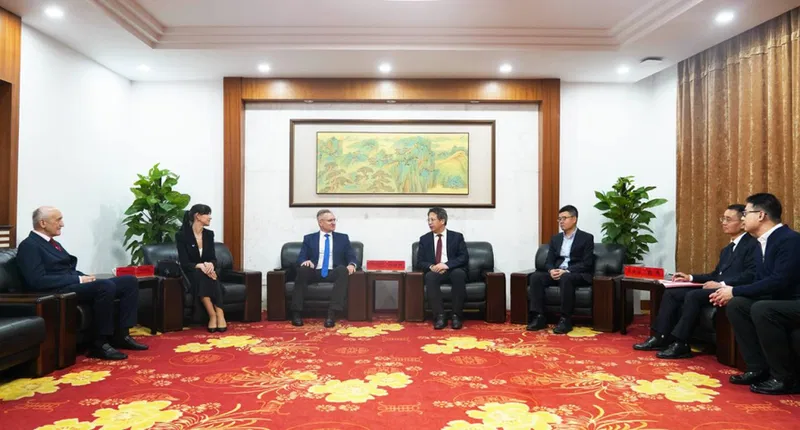
The delegation of Ufa University during its visit to Changzhou University in China. (Source: Ufa University’s Website)
Other than that, UUNiT also stated its plans to step up the already existing student exchange arrangements with China’s Nanjing University of Technology, as part of which students and postgraduates from Nanjing Tech University are pursuing internships at UUNiT.
Also, two months before the aforesaid Scientific and Educational Cooperation agreement between the MSTU and Beijing Institute of Technology in 2022, UUNiT had also reached a similar agreement with China’s Shenyang Engineering Institute, as part of which, the two universities are working on the joint educational program ‘Electroenergetics and automation’, where up to 100 students from China are enrolled every year and UUNiT teachers travel to the Shenyang Engineering Institute to teach courses in English.
Moreover, UUNiT is also going to expand the scope of its cooperation with China’s Liaoning University to include the field of science and education in addition to already existing areas such as Economics and Philology.
UUNiT is known to have been involved in research related to power plants and systems used in Russian civil and military aviation, and among its aforesaid exchange programs with Chinese institutes, those with Nanjing Tech University is perhaps the most noteworthy, considering its known involvement in defense-related research and training, particularly in areas of materials science, chemistry, optical engineering and systems engineering.
Shortly after this, on November 12, Russia’s Ural Federal University (UrFU) and China’s Liaoning University of Technology (LNTU) signed an agreement to launch a joint institute, the first intake of which is slated to happen in September 2026. This institute shall impart bachelor’s programs in mechatronics and engineering and master’s programs in mechanical engineering, artificial intelligence, electrical power engineering, and applied artificial intelligence.

Comments
No comments yet. Be the first to comment!