
The Chinese Communist Party’s (CCP’s) Legitimacy Crisis and Implications for Taiwan
The Chinese Communist Party (CCP) is facing considerable challenges to its legitimacy, which has historically been based on two foundational pillars: the promise of prosperity and the concept of ‘national rejuvenation’ (民族復興), which includes reunification of Taiwan with the...

The Chinese Communist Party (CCP) is facing considerable challenges to its legitimacy, which has historically been based on two foundational pillars: the promise of prosperity and the concept of ‘national rejuvenation’ (民族復興), which includes reunification of Taiwan with the Chinese mainland as a vital aspect. The first pillar is evidently faltering amid slowing economic growth and rising discontent among the Chinese population, consequently amplifying the potential for the CCP leadership to resort to act on Taiwan as a means to bolster internal legitimacy.
The People’s Republic of China (PRC) has been reeling with several socio-economic challenges currently which include the slowdown in domestic consumer demand, increasing indebtedness, demographic decline, and discontent within the Chinese citizenry due to corruption among local CCP cadre as well as widening economic inequalities between rural and urban regions.
Now, from a geopolitical risk perspective, there are several reasons to explore these pressing issues that China is facing, however, the focus of this article is going to be on the nature of risks that these socio-economic issues carry for the island nation of Taiwan which the CCP intends to unify with mainland China, either peacefully or by use of force.
So, the Author’s previous article, ‘ Will China Move To Occupy Taiwan’s Offshore Islands?’, published on November 14 th, received pushback from some of the ‘Unravelling Geopolitics’’ readers, and it was a very thoughtful, or the more appropriate word would be a ‘rational’ pushback, which the Author thought warranted a more thorough response.
Advertisements
Specifically speaking, the aforesaid article made an argument that China’s increasingly frequent incursions and maritime operations in waters surrounding Tawain and its outlying islands, when viewed together with some of China’s economic enticements to manipulate public opinion on these islands in a bid to undermine Taiwan’s control of these islands, creates enough ground to suspect a possible attempt by China to absorb one of Taiwan’s outlying island groups whenever circumstances are sufficiently conducive in Beijing’s view.
Now, some of the readers expressed skepticism at the prospect of China occupying any of Taiwan’s outlying islands because it carries risk of emboldening Taiwanese independence movement as well as does away with the status quo defined by ambiguity, and for what? A mere symbolic victory of occupying some ‘inconsequential islands’.
So, from a cost-benefit perspective, the Author agrees with the above assertion but that is a purely rational way of thinking, and in strategic intelligence, failure of imagination often happens due to the assumption that decisionmakers will always act rationally.
Moreover, it is also important to gauge what form rationality can assume for a certain decisionmaker in a certain circumstance. Politicians do not always act in the best interest of their country, meaning, at times they opt to act in a manner that serves their own interests even if it conflicts with what is good for their country.
Now, this becomes even more pronounced in a country like China which is ruled by a single party, that is the Chinese Communist Party (CCP), especially with the rise of Xi Jinping which has led the CCP’s rule over China to again take the form of a personalized strongman rule similar to that of Mao Zedong, which not only affords him with the ultimate authority over the Party and the State but also solely places the ultimate responsibility of ensuring continued rule of the CCP over China on his shoulders.
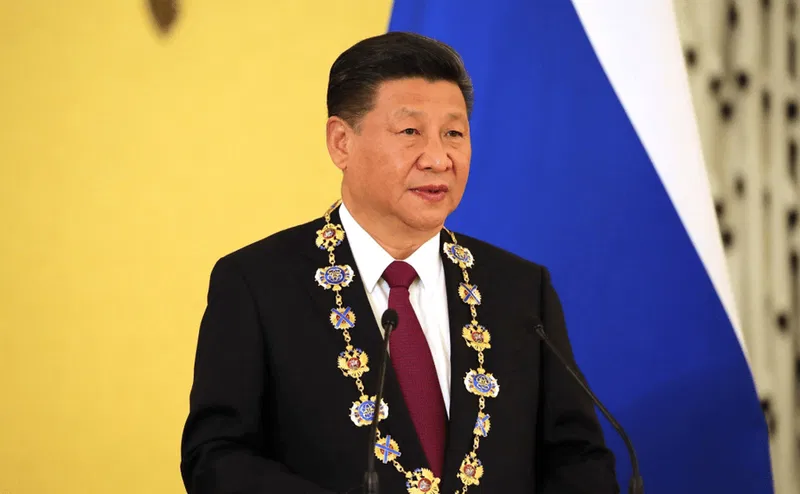
China’s President and the Secretary General of the Chinese Communist Party (CCP), Xi Jinping. (Image Source: Kremlin.ru)
In simple words, Xi holds the very fate of the Chinese Communist Party (CCP) and by extension the People’s Republic of China (PRC), in his hands, at a time when the CCP’s legitimacy is being severely undermined in the eyes of the Chinese populace because of the ongoing economic downturn and several other causes of social tensions.
In this article then, the Author shall first try and substantiate his assertion that China’s socio-economic realities are indeed so worrisome that it threatens the CCP’s legitimacy, and then postulate as to how the prospect of occupying one or more of Taiwan’s offshore islands could present itself as the most optimal course ahead for the CCP’s top leadership in their struggle to ensure the continued rule of the Party over China.
So, let us begin.
Is The Chinese Communist Party (CCP) Losing The ‘Mandate Of Heaven’?
In 1046 BCE, the Zhou clan in China invoked a political doctrine called the ‘Mandate of Heaven’ to justify their overthrow of the ruling Shang dynasty.
According to this doctrine, Heaven (天 Tian) bestows its mandate on a virtuous ruler, referred to as the Son of Heaven (天子, Tianzi), who will rule the world (天下, Tianxia), and the retention of this mandate is contingent upon the just and effective governance of the rulers and their descendants.
Linked to the principle of the Mandate of Heaven was the right of rebellion against an unjust ruler. So, the occurrence of natural disasters or times of economic hardship were interpreted as signs of Heaven’s disapproval of the ruler, which would often lead to revolts as people thought that the incumbent ruler had forfeited the Mandate of Heaven and needed to be replaced.
Advertisements
The Zhou clan argued that the Shang rulers had lost the Mandate of Heaven because of their corrupt practices and wrongdoings that caused social turmoil and instability, and ultimately resulted in their overthrow by the Zhou, which marked the transfer of this mandate to the Zhou clan. Likewise, they claimed that the Shang dynasty had also succeeded the Xia dynasty before them in 1500 BCE with the backing of the Mandate of Heaven.1
By invoking this political doctrine, the Zhou rulers had to acknowledge that any ruling clan, including themselves, could be overthrown if they lose the mandate of heaven due immoral conduct and unjust governance.
So, when the Zhou dynasty was overthrown by the Qin state during the Warring States period (475–221 BC), the Qin similarly proclaimed that they had been bestowed the mandate from Heaven.
Likewise, throughout Chinese history following the advent of Zhou dynasty, this political doctrine as been used to legitimise the successful ouster of ruling dynasties and the installation of new ones, thereby making it the single most important contribution of the Zhou dynasty to Chinese political thought.
Philosophers and scholars in China would often invoke the Mandate of Heaven to curb the abuse of power by rulers, while the historians interpreted successful revolts as evidence that a ruler had lost this mandate.
Consequently, the rulers in China exerted substantial efforts to maintain effective governance, enhance public welfare and uphold public order, and in the event of natural disasters, social unrest or governance failures, the monarch was obligated to assume responsibility, thereby making performance legitimacy an essential feature of Chinese history and politics.
So much so that this political doctrine continues to influence the mindset of the Chinese people even today, with the Chinese Communist Party (CCP) that governs them, continuing to rely on its performance to retain its legitimacy in the eyes of the Chinese populace, as will be demonstrated later in this section using the primary Chinese-language sources affiliated with the CCP.
The CCP’s Struggle With China’s Economic Stagnation
In recent years, several experts outside and inside China have been disputing the PRC’s narrative of its economic progress. For instance, experts at the US-based Rhodium Group have been pointing out several incongruities between China’s officially released macro-economic data and its policy actions.
So, officially, China’s real GDP growth rate dropped only by 0.4 percentage point (pp) from 5.4% in 2023 to 5% coming into the end of 2024, however, experts at Rhodium Group state in their research that these GDP figures are impossible to reconcile with the several huge adjustments that the Chinese government made to its economic policy in 2024.
These adjustments, as pointed out by Rhodium Group, include aggressive cuts to interest rates, a mid-year budget adjustment not seen since the Asian financial crisis, a 10 trillion yuan ($1.4 trillion) refinancing program for local government debt, creation of new liquidity facilities for the central bank to directly support the stock market, changing the official monetary bias to “appropriately easing” for the first time since the global financial crisis, and calling for “extraordinary” support for the economy in the December Politburo meeting.
According to the Rhodium Group experts, no government should have to undertake such adjustments to its economic policy to counter a minor slowdown in growth rate of 0.4 pp.
Also, in December 2024, Gao Shanwen, who was chief economist at China’s state-owned SDIC Securities at the time, said in a speech during an investors’ meeting in Shenzhen that the Chinese government likely overstated the GDP numbers by 3 percentage points annually over the past three years.

Comments
No comments yet. Be the first to comment!