
Transforming Eurasian Trade: The Middle Corridor’s Role Post-2022
For several years, the Middle Corridor was only making gradual progress, however, with the onset of Russia-Ukraine conflict in 2022 and the ensuing intensification of sanctions on Russia as well as Ukraine’s concerted attacks on Russian critical infrastructure linked to...

For several years, the Middle Corridor was only making gradual progress, however, with the onset of Russia-Ukraine conflict in 2022 and the ensuing intensification of sanctions on Russia as well as Ukraine’s concerted attacks on Russian critical infrastructure linked to international transit routes, it has become a key alternative for trade between Europe and Asia, particularly China with other countries like Japan and South Korea also beginning to come in.
Before the Russia-Ukraine conflict, more than 90% of the rail traffic between Europe and the Far East was carried along the Northern Corridor that passes through Russia, however, as a result of the sanctions in 2022, shipments reduced over the Northern Corridor by 40% while the support for the Trans-Caspian International Transport Route (TITR), commonly known as the Middle Corridor began increasing.
The Middle Corridor or the TITR starts from Southeast Asia and runs to European countries through Central Asia, the Caspian Sea, and the South Caucasus. It combines rail, sea, and road transportation modes and provides an alternative to traditional routes through Russia.
It has Northern and Southern branches, of which, the Northern branch goes through Kazakhstan, while the Southern branch passes through Turkmenistan and Uzbekistan.
After taking a ferry across the Caspian Sea, the TITR divides into two routes: one crosses the Black Sea from Batumi, Georgia, to harbours in Romania and Bulgaria and the other overland through Turkiye to the Balkan countries.
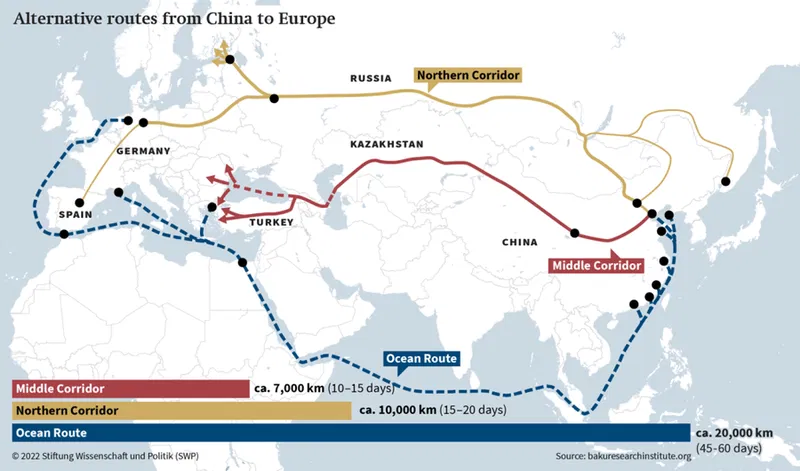
Trade Transit Routes From China To Europe (Image Source: Baku Research Institute)
There was unprecedented surge in the traffic via the TITR in 2022, with cargo volume growing by 2.5 times to 1.5 million tonnes and in 2023, the rail freight along this route also increased by more than 60% to 433,000 tonnes in the first quarter of 2023.
As the demand increased, the Central Asian and Caucasian countries began actively developing their infrastructure along this route with Kazakhstan Uzbekistan, Kyrgyzstan aggressively expanding their rail networks, while Azerbaijan and Kazakhstan improving the capacity of their Caspian Sea ports and ferries.
In April 2022, the Danish shipping giant Maersk began operating a rail service through the “Middle Corridor.” Per the company’s statement, the route was started “in response to customers’ ever-changing supply chain needs in the current extraordinary times.” On April 13, 2022, the first train to embark on the new service departed from Xi’an, China, traveling through Kazakhstan, the Caspian Sea, Azerbaijan, and Georgia, before crossing the Black Sea to Romania and eventually arriving in Germany.
On May 10, 2023, Nurminen Logistics, a Finnish company, began operating a container train across the Caspian Sea connecting China to Central Europe via the Trans-Caspian route. The route had been created “in two months from scratch.”
So, in addition to geopolitical developments, the aforementioned efforts to raise the standard and conditions of transit routes along the Middle Corridor were also instrumental in favourably impacting the transit related figures. For instance, in the first four months of 2023, 8,696 containers passed through Azerbaijan, a 130% rise from the corresponding period in 2022.
In 2024, the middle corridor saw a 25-fold increase in freight volumes from China to Europe, with Azerbaijan playing a pivotal role in this growth. A total of 358 container block trains ran via the TITR between the PRC–Central Asia–Azerbaijan in the previous year, and in 2025, Azerbaijan Railways plans to more than triple the number of block trains that run along the TITR to 1,000.
Advertisements
Also, the Middle Corridor traverses the boundaries of several countries, offering access to new markets with an estimated population of over 80 million along the route, and countries along this route such as Azerbaijan, Kazakhstan and Turkmenistan intend to create logistical hubs and free trade zones in their ports in order to stimulate local economies.
That said, it is important to bear in mind that the Northern Corridor still remains the most efficient route for exports to Europe from Asia, and while the fallout of the Russia-Ukraine conflict did divert some of the traffic from Northern Corridor to the Middle Corridor, much of the decline this traffic via the former route was actually due to other factors completely unrelated to the crisis in Ukraine, which have been discussed previously by the Author in sufficient detail.
So, the Middle Corridor handled up to 10,800 TEUs of trans-Eurasian container traffic in 2022, which is a mere 2.6% of the volume on the northern route, and even that fell substantially in the first 7 months of 2023 by 77% of the level in the similar period the year before.
This is because, this route is fraught with various technical and logistical difficulties. Despite being shorter in length than the Northern Corridor, it remains slower and more expensive than the latter, as it involves multimodal transfers to cross the sea and greater number of border crossings.
Above all, the complex nature of transit and trade procedures in countries that the Middle Corridor traverses make the border crossings unpredictable and this coupled with infrastructure bottlenecks in maritime, rail, and road transport throughout the entire route renders the TITR as a very complicated and unreliable pathway.
Conversely, the Northern Corridor features lot of developed infrastructure and offers a lengthier but an uninterrupted transit.
As a result, despite its longer distance, the Northern Corridor boasts the shortest average transit times of 14 days, while the Middle Corridor’s transit times range from 13 to 21 days, with the possibility of delays extending this timeframe up to 60 days in the worst-case scenarios.
Therefore, it is important to realistically assess the economic viability of the TITR or the Middle Corridor by discussing the efforts being undertaken by countries along the Middle Corridor to develop the infrastructure and improve the standard and conditions of transit routes along the TITR, as well as try and gauge the potential of these efforts to favourably impact the transit related figures of this corridor in the long run, which is the purpose of this article.
So, let us begin.
Problems With The Middle Corridor And Efforts Being Undertaken To Address Them
The main challenge confronting the Middle Corridor at present is the irregularity of service, stemming from numerous infrastructural, administrative, and political barriers. These include limited capacity at seaports and railroads, lack of a uniform tariff structure, and occasional political instability.
All this, together with the huge distances overland and the need to change transport modes – including two maritime transports – make the route slower and more expensive than the Northern route.
In August 2024, the dredging group Jan De Nul (JDN) announced the construction of a new deep-sea port in Anaklia, Georgia, as well as the expansion of the ports of Kuryk, Kazakhstan and Mersin in Turkey.
The plan entails building a breakwater, access channels and turning points for a new deep-sea port in Anaklia, Georgia, and capital dredging work for the expansion of the ports of Kuryk in Kazakhstan and Mersin in Turkey.
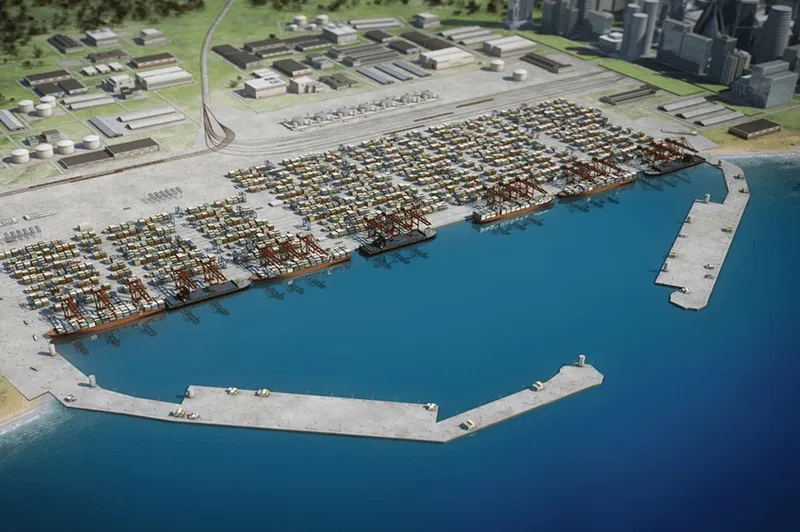
Anaklia Deep Sea Port Project (Image Source: Anaklia Development Consortium)
“The maritime trade route through the Caspian and Black Seas is considered a reliable alternative to the northern route through Russia, or the southern route via the Suez Canal. However, the existing sea ports currently act as bottlenecks for cargo traversing the route,” said the company, adding that the three port projects “will effectively address the challenges.”
As of September 2024, JDN group had completed capital dredging for the expansion of Mersin Port in Turkey.
Port expansion is crucial for enhancing the Middle Corridor, Azwe Aliyez, managing director – Caucasus and Central Asia, at Trans Global Projects, was quoted as saying by Breakbulk Magazine in its Issue 6 of 2024, which came out in November 2024.
However, he also pointed out that while the development projects at Anaklia and Kuryk will improve port capacity to handle oversize and overweight cargo, the key challenges are linked to the road and rail infrastructure along the Middle Corridor.
“Although we are seeing significant improvements in this area, there is still considerable work to be done. That said, these developments are promising steps towards better facilitating such cargo, and we are optimistic about the future,” Aliyez said.

Comments
No comments yet. Be the first to comment!