
Is The United States Looking To Make A Quite Comeback In Afghanistan To Reassert Its Primacy In Asia’s Strategic Heartland?
While the news related to Greenland, Iran, and Venezuela have attracted a lot of eyeballs globally, what is going largely unnoticed is the United State’s behind the scenes engagement with Afghanistan, possibly in a bid to reassert its influence across South, West, and Central...

In his latest trip, Khalilzad met with the Taliban government’s Foreign Minister Amir Khan Muttaqi in Kabul. After the meeting, the Islamic Emirate’s Foreign Ministry said that “following the withdrawal of foreign forces and the end of the war, engagement between the Taliban and the United States has effectively entered a new phase.”
Muttaqi also noted that there are opportunities available across various sectors to further develop relations between the two sides, which could be pursued through sustained dialogue.
While initially it was not clear whether Khalilzad travelled to Kabul on an official mission or in a personal capacity, as he is no longer an employee of the US government but he had previously travelled to Afghanistan with US officials to help secure the release of American prisoners held by the Taliban.
However, a spokesperson for the US State Department, in comments to Afghan International, said that Khalilzad is not a US government employee and that his recent activities are carried out in a personal capacity.
Nevertheless, the Taliban’s decision to host Khalilzad at the foreign minister-level, along with Muttaqi’s remarks of the engagement between the Taliban and the US having effectively entered a new phase, suggests that the group regards him as a potential intermediary who with his experience and network, can help improve its relations with the United States.
What also fuels these speculations is the US President Donald Trump’s several remarks in September 2025 about efforts being undertaken to retake control of the Bagram Air Base in Afghanistan after it was taken over by Taliban following the US’ withdrawal from the country in 2021.
First such remark was made at Trump’s joint press conference with the UK’s Prime Minister Keir Starmer during his state visit to the UK in 2025, wherein he said that efforts are underway to retake control of Bagram Air Base which would gain the US a foothold against China.
“We were going to leave Afghanistan, but we were going to leave it with strength and dignity and we were going to keep Bagram, the big air base, one of the biggest airbases in the world. We gave it to them for nothing. We’re trying to get it back, by the way, okay, that could be a little breaking news. We’re trying to get it back because they need things from us. We want that base back. But one of the reasons we want the base is, as you know, it’s an hour away from where China makes its nuclear weapons,” said Trump.
A few days later, Trump re-iterated his intent to retake control of Bagram Airbase for the US on his social media platform, ‘Truth Social’.
“If Afghanistan doesn’t give Bagram Airbase back to those that built it, the United States of America, BAD THINGS ARE GOING TO HAPPEN!!!” posted Trump on Truth Social, without specifying what exactly those ‘BAD THINGS’ would be, which is very typical of Trump: keep the opponents in suspense by intensifying the rhetoric to force negotiations or favourable outcomes in negotiations.
The American media reporters, however, were not going to let him off the hook so easily, so they asked him during an interaction at the White House to clarify his stance and whether ‘BAD THINGS’ meant he would consider deploying US troops to take the base.
In response to that Trump said “we won’t talk about that, but we’re talking now to Afghanistan, and we want it back and we want it back soon, right away. And if they don’t do it, you’re going to find out what I’m going to do.”
Now, if the US’ recent action in Venezuela under Trump’s Presidency is any indication, his rhetoric about Bagram airbase must not be taken lightly. In fact, Venezuela is just the latest example.
Other such examples of Trump administration’s decisive foreign policy actions include the US’ operation ‘Midnight Hammer’ against Iran and weaponization of tariffs to reduce Russia’s oil exports which forced both India and China to reduce their oil imports from Russia.
Therefore, even if Trump has not yet specified what exact measures his administration is prepared to take to regain control over Bagram Air Base, his resolve to get things done must not be underestimated, especially considering the United States’ extraordinary military and economic wherewithal that tend to make his decisions a success.
However, Taliban in all of its responses to Trump’s remarks about Bagram Air Base have categorically rejected any prospect of handing over “even an inch of Afghanistan’s soil” to the US military, and the group’s 20 years of struggle against the US military presence in Afghanistan that ultimately compelled the US to pull out from the country is also a testament to its resolve.
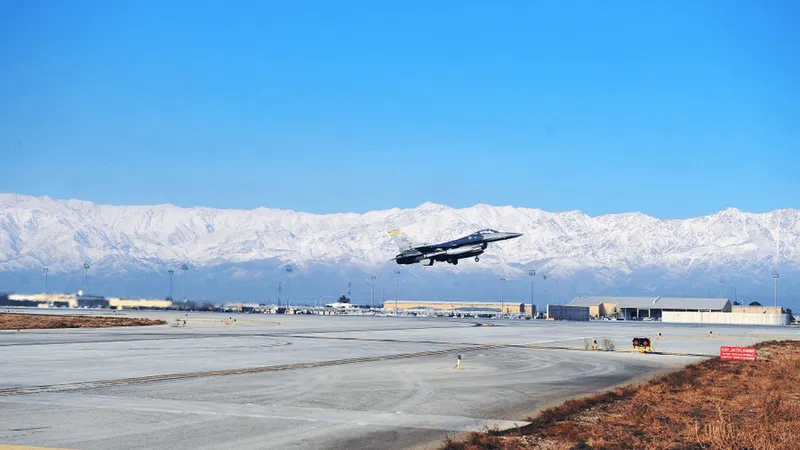
A USAF F-16 Fighting Falcon taking off at Bagram Airfield in January 2015 (Image Source: US Air Force (USAF))
Also, while the Author does not agree with the Taliban’s governing ideology at all but he must acknowledge the fact that this group is a legitimate Afghan entity comprising Afghan people belonging to the predominantly agrarian tribal feudal Afghan society.
The reason why this acknowledgement is important is because it serves to point out that the notion of resistance to foreign occupation is deeply entrenched in the Afghan society.
So, the US’ withdrawal from the country in 2021 after 20 years of unsuccessfully trying to eradicate Taliban from Afghanistan, is just a latest example of Afghans successfully holding on their own against a superior foreign power. Before that, the erstwhile Soviet Union and British Empire have also had the taste of failure against strong resistance from within the Afghan society.
Overall, the resolve of the Afghans to resist foreign domination predates Trump’s resolve to get his way, by at least more than 180 years, which has earned Afghanistan the reputation of being a ‘Graveyard of Empires’, wherein all great powers who once thought that their superior military and economic wherewithal can bring about a swift subjugation of Afghan populace, were eventually humbled when they actually brought it all to bear in the geographically harsh and politically inhospitable landscape of Afghanistan.
So, the first question is whether the incumbent US President will repeat the same historical pattern for the United States.
As of now, all we know is that the Trump administration is in talks with the Taliban, even if it is via unofficial channels, and the two sides appear keen to expand their relationship for potential benefits that can come off it.
The Trump administration holds US$7 billion worth of Afghanistan’s overseas assets in freeze, as well as diplomatic recognition and lifting of sanctions by the United States is key to foreign investment in Taliban-ruled Afghanistan. While Taliban holds access to a strategically significant geography of Afghanistan which could prove to be indispensable for the US in its ongoing competition with China.
So, the second question is whether President Trump and the Taliban’s leadership could actually manage to find a middle ground between the two ideologically opposed worldviews on the altar of potentially converging pragmatic national interests, wherein the Taliban-ruled Afghanistan agrees to form some kind of an international posture together with the United States.
Currently, it is difficult to say anything with certainty, so this article with the help of these two questions will instead seek to articulate the contours of the uncertainty surrounding the US’ ongoing backchannel engagement with Taliban to assess its potential implications for various stakeholders across South, West, and Central Asia.
So, let us begin.
Washington’s Regret Over Ceding The Strategic Space To The US’ Rivals
There is an opinion among a section of the American intelligentsia that leaving Bagram airbase was probably a mistake because its utility extended far beyond the US’ war on terror in Afghanistan, offering a position for power projection across a vast region encompassing Iran to the west, Pakistan and India to the east, the former Soviet republics of Central Asia to the northeast, and most importantly, the western regions of China.
Bagram lies around 60 kilometers to the north of Kabul, in the Parwan province. The airbase it hosts is the largest in Afghanistan with two long runways capable of handling heavy bombers, drones, and strategic airlift and hangars that can house rows of fighter jets.
Located less than 400 kilometers from China’s western Xinjiang region, where Beijing is currently undertaking the largest nuclear expansion in Chinese history, Bagram can offer the US a great vantage point for intelligence, surveillance, and reconnaissance of China’s nuclear buildup as well as a position from where its fighter jets and bombers can potentially threaten the Chinese territory.

Comments
No comments yet. Be the first to comment!